Risk Analysis in line with ISO 27001 & BSI
With Leno ISR, you can conduct risk analyses in accordance with ISO 27001 and BSI IT-Grundschutz in a structured, consistent, and audit-ready manner. Risks are assessed based on the information network, the protection needs assessment, and defined threat and vulnerability scenarios - providing a solid foundation for mitigation measures, management decisions, and compliance.
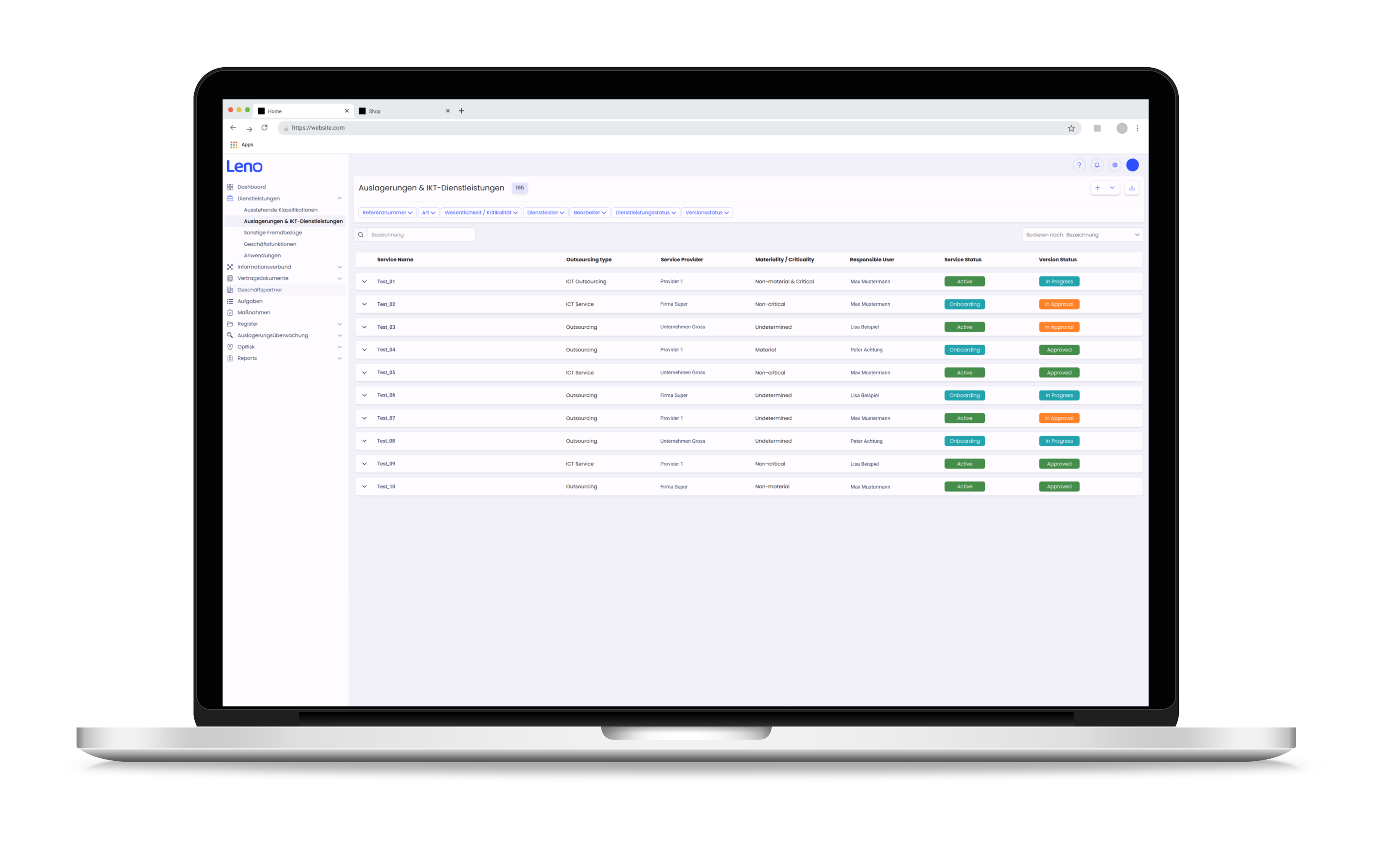
Why IT risk analyses are challenging in practice
.png)
Lack of a systematic approach
- Risks are not assessed using a consistent methodology
- Protection needs, threats, and vulnerabilities are not clearly linked
- Results are difficult to compare
Isolated and manual assessments
- Risk analyses are performed in spreadsheets or standalone tools
- Links between risks and mitigation measures are not fully traceable
- High manual maintenance effort
Limited timeliness and audit readiness
- Changes in the information network are not consistently reflected
- Risk decisions are difficult to explain retrospectively
- Increased risk of audit findings
%201.png)
How Leno supports risk assessment and risk analysis
Risk analysis based on a target–actual comparison
- Direct linkage to the results of the protection needs assessment
- Automatic derivation of vulnerabilities and threats as a basis
- Flexible rating scales aligned with your individual risk matrix
Structured risk assessment
- Assessment of likelihood and impact using Monte Carlo simulation
- Consideration of defined threat and vulnerability scenarios
- Transparent risk calculation and prioritization
Linkage to mitigation measures and risk treatment
- Derivation of appropriate measures from identified risks
- Automatic transfer to the risk register
- Clear responsibilities and status tracking
%20%202%20(1).png)
Why risk analysis can be implemented more efficiently with Leno
Many organizations rely on static or isolated approaches to risk analysis. Leno combines methodology, data, and automation in a single integrated platform.

.avif)

.png)
.png)
.png)
Other Tools

Sofort einsatzbereit. Und dennoch individuell.
Die Einführung von Leno erfolgt strukturiert, effizient und ohne Programmieraufwand. Gemeinsam konfigurieren wir Module wie TPRM, CLM oder ISR anhand bewährter Vorlagen – revisionssicher und regelkonform nach DORA, MaRisk, BAIT und EBA-Leitlinien. Leno bietet out-of-the-box ein standardisiertes Rahmenwerk, das sich einfach und effizient an Ihre internen Prozesse und Bedürfnisse anpassen lässt.
- Fragebögen, Risikoanalyse, Szenarien anpassen
- Rollen, Freigaben und Leserechte festlegen
- Reports & Metriken definieren
Key questions on risk assessment and risk analysis
1. Was ist die Leno?
Leno ist eine modulare Plattform für Governance, Risk & Compliance (GRC), die Unternehmen bei der Automatisierung und Digitalisierung von Compliance- und Risikomanagement-Prozessen unterstützt. Mit Leno etablieren Sie Auslagerungsmanagement, Vertragsmanagement, Informationssicherheit und BCM etablieren.
2. Welche Module bietet Leno?
Leno ist modular, integriert und automatisiert.
Aktuell stehen folgende Module zur Verfügung:
- Leno TPRM – für Third Party Risk Management und Auslagerungsmanagement
- Information Security & Resilience (ISR) – für Informationssicherheitsmanagement und Business Continuity Management (BCM)
- Leno CLM – für Vertragsmanagement
Alle Module greifen nahtlos ineinander und bilden gemeinsam ein ganzheitliches Governance-, Risk- und Compliance-Management (GRC) ab.
3. Wie ist die Leno Plattform technisch aufgebaut?
Leno ist eine webbasierte Cloud-Plattform, entwickelt nach modernen Sicherheits- und Architekturstandards. Die Lösung ist skalierbar, mandantenfähig und kann flexibel an Ihre internen Strukturen, Prozesse und Berechtigungen angepasst werden.
4. Ist Leno sicher?
Ja. Sicherheit steht bei Leno an oberster Stelle. Die Plattform erfüllt höchste Anforderungen an Datenschutz, Informationssicherheit und Compliance. Alle Daten werden verschlüsselt gespeichert und übertragen, und das Hosting erfolgt in zertifizierten Rechenzentren innerhalb der EU.
5. Kann Leno in bestehende Systeme integriert werden?
Ja. Über standardisierte Schnittstellen (APIs) kann Leno problemlos in bestehende Systeme wie ERP-, GRC- oder CMS-Lösungen integriert werden. Damit lassen sich Daten für Dienstleister, Verträge und Risiken effizient synchronisieren.
6. Ist Leno mehrsprachig verfügbar?
Ja. Die Plattform unterstützt standardgemäß Deutsch und Englisch. Weitere Sprachen können auf Anfrage ergänzt werden.
7. Wie erfolgt die Benutzerverwaltung?
Kunden authentifizieren sich über Single Sign-On (SSO).Leno bietet eine rollenbasierte Benutzer- und Rechteverwaltung, mit der sichergestellt wird, dass Ihr Berechtigungskonzept automatisch abgebildet wird.
8. Welche Unterstützung bietet Leno beim Onboarding und Support?
Unsere Experten begleiten Sie von der Einführung bis zum produktiven Betrieb. Wir bieten Schulungen, technische Unterstützung und laufenden Support, um eine reibungslose Nutzung der Plattform sicherzustellen. Auf Wunsch übernehmen wir auch die initiale Datenmigration und Konfigurationen, sofern notwendig.
9. Wird Leno regelmäßig aktualisiert?
Ja. Leno wird kontinuierlich weiterentwickelt. Regulatorische Änderungen, Optimierungen und neue Funktionen werden regelmäßig bereitgestellt, sodass Sie immer auf dem neuesten Stand bleiben.
10. Welche Vorteile bietet Leno gegenüber anderen GRC-Plattformen?
- Hoher Automatisierungsgrad durch KI- Modularer Aufbau
und flexible Erweiterbarkeit
- Schnelle Implementierung und intuitive Benutzeroberfläche
- Regulatorische Expertise direkt in der Software abgebildet
- Hosting & Support aus Deutschland
Lorem ipsum dolor sit amet, consectetur adipiscing elit. Suspendisse varius enim in eros elementum tristique. Duis cursus, mi quis viverra ornare, eros dolor interdum nulla, ut commodo diam libero vitae erat. Aenean faucibus nibh et justo cursus id rutrum lorem imperdiet. Nunc ut sem vitae risus tristique posuere.
The risk analysis in accordance with BSI Basic Protection and ISO 27001 is used to systematically identify, evaluate and prioritize information security-relevant risks. It forms the basis for selecting suitable security measures within the framework of an ISMS.
Lorem ipsum dolor sit amet, consectetur adipiscing elit. Suspendisse varius enim in eros elementum tristique. Duis cursus, mi quis viverra ornare, eros dolor interdum nulla, ut commodo diam libero vitae erat. Aenean faucibus nibh et justo cursus id rutrum lorem imperdiet. Nunc ut sem vitae risus tristique posuere.
ISO 27001 allows a flexible, risk-based methodology, while the BSI basic protection is more standardized and catalogue-based. However, both approaches have the same goal: to make risks transparent and to deal with them appropriately. Leno supports both methods as well as hybrid approaches.
Lorem ipsum dolor sit amet, consectetur adipiscing elit. Suspendisse varius enim in eros elementum tristique. Duis cursus, mi quis viverra ornare, eros dolor interdum nulla, ut commodo diam libero vitae erat. Aenean faucibus nibh et justo cursus id rutrum lorem imperdiet. Nunc ut sem vitae risus tristique posuere.
Risks arising from threats and vulnerabilities relating to information objects, processes and applications are considered. These include technical, organizational and external risks.
Lorem ipsum dolor sit amet, consectetur adipiscing elit. Suspendisse varius enim in eros elementum tristique. Duis cursus, mi quis viverra ornare, eros dolor interdum nulla, ut commodo diam libero vitae erat. Aenean faucibus nibh et justo cursus id rutrum lorem imperdiet. Nunc ut sem vitae risus tristique posuere.
A risk analysis must be reviewed regularly and updated at least once a year. In addition, an event-specific update is required, for example in the event of changes in the information network, new threats or significant process adjustments.
Lorem ipsum dolor sit amet, consectetur adipiscing elit. Suspendisse varius enim in eros elementum tristique. Duis cursus, mi quis viverra ornare, eros dolor interdum nulla, ut commodo diam libero vitae erat. Aenean faucibus nibh et justo cursus id rutrum lorem imperdiet. Nunc ut sem vitae risus tristique posuere.
The protection requirements analysis determines how valuable information, processes or applications are. The risk analysis then assesses which risks these protection requirements are exposed to and how high the potential effects are. Both analyses build on each other logically.
Lorem ipsum dolor sit amet, consectetur adipiscing elit. Suspendisse varius enim in eros elementum tristique. Duis cursus, mi quis viverra ornare, eros dolor interdum nulla, ut commodo diam libero vitae erat. Aenean faucibus nibh et justo cursus id rutrum lorem imperdiet. Nunc ut sem vitae risus tristique posuere.
Risk analysis is a central test criterion for ISO 27001 certifications and internal audits. Auditors expect comprehensible methodology, up-to-date assessments and a clear derivation of measures.
Vereinbaren Sie einen Termin
Demo buchen
.avif)
Wie können wir Ihnen helfen?
Kontaktieren Sie uns.