
Criticality analysis of business functions
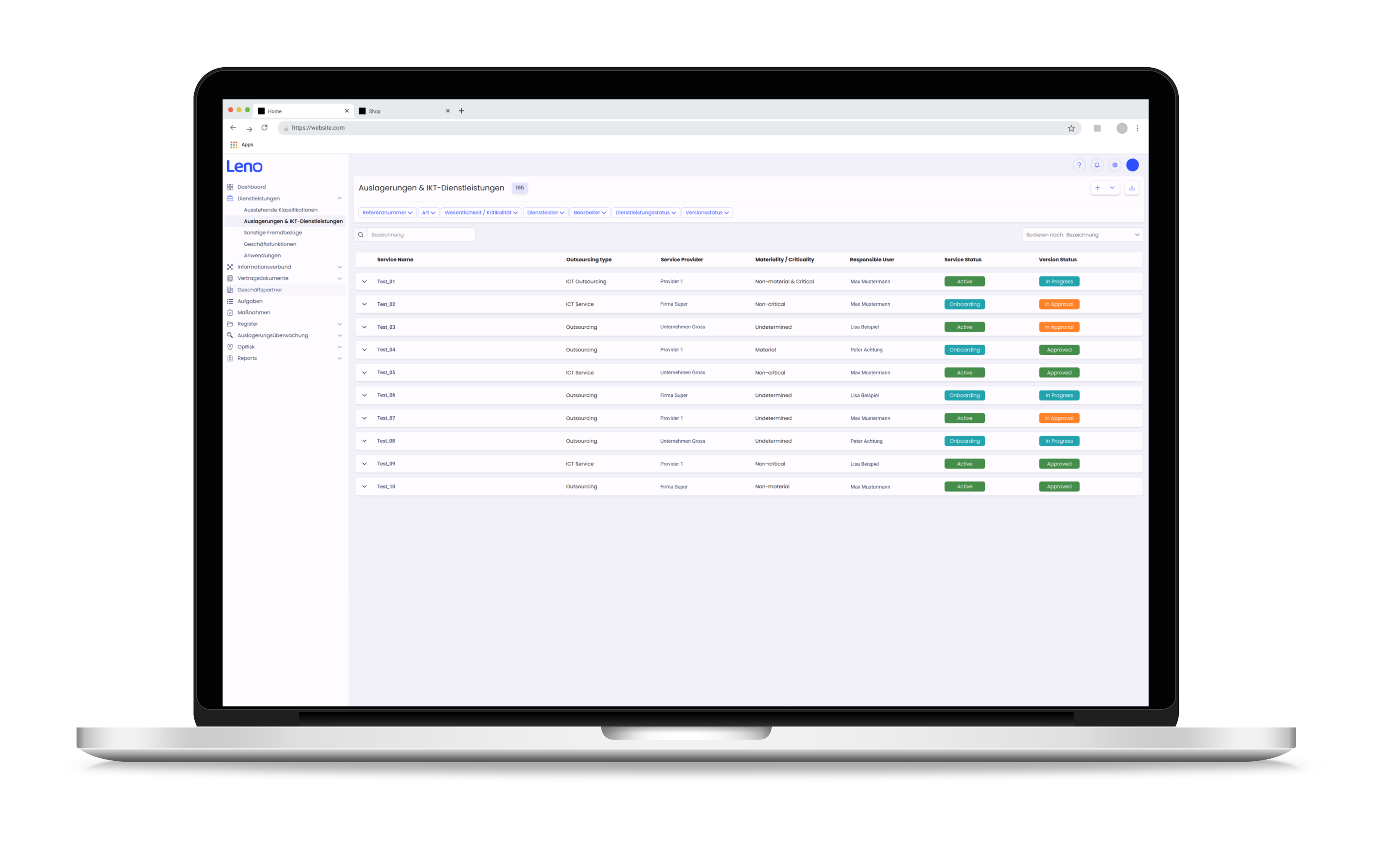
With Leno ISR, you can identify and assess critical or important business functions in accordance with DORA in a structured, traceable, and consistent manner. The criticality analysis forms the foundation for managing ICT risks, third parties, outsourcing arrangements, and the DORA Register of Information.
Why criticality analysis under DORA is challenging
- Business functions are not defined consistently
- Distinction between critical and non-critical functions is inconsistent
- Results are difficult to compare
- Criticality analysis is equated with BIA
- Different objectives are not clearly separated
- Regulatory requirements under DORA are only partially met
- Dependencies on ICT systems, applications, and third parties are unclear
- Implications for the DORA Register of Information are not traceable
- High manual effort for supervisory inquiries
%201.png)
How Leno supports criticality analysis in line with DORA
- Consistent capture and definition of business functions
- Assessment of criticality based on DORA-relevant criteria
- Clear documentation of classifications
- Linking business functions to ICT systems and applications
- Mapping dependencies on ICT third parties and outsourcing arrangements
- Using results for TPRM and the Register of Information
- Direct derivation for the DORA Register of Information
- Consistent data basis for supervisory requests
- Full traceability of all decisions
%20%202%20(1).png)
Why criticality analysis can be implemented more efficiently with Leno
Many institutions identify critical functions manually or in isolated documents. Leno integrates criticality analysis seamlessly into the existing information network.
Other Tools



.png)
.png)
.png)
Frequently asked questions on criticality analysis under DORA
1. Was ist die Leno?
Leno ist eine modulare Plattform für Governance, Risk & Compliance (GRC), die Unternehmen bei der Automatisierung und Digitalisierung von Compliance- und Risikomanagement-Prozessen unterstützt. Mit Leno etablieren Sie Auslagerungsmanagement, Vertragsmanagement, Informationssicherheit und BCM etablieren.
2. Welche Module bietet Leno?
Leno ist modular, integriert und automatisiert.
Aktuell stehen folgende Module zur Verfügung:
- Leno TPRM – für Third Party Risk Management und Auslagerungsmanagement
- Information Security & Resilience (ISR) – für Informationssicherheitsmanagement und Business Continuity Management (BCM)
- Leno CLM – für Vertragsmanagement
Alle Module greifen nahtlos ineinander und bilden gemeinsam ein ganzheitliches Governance-, Risk- und Compliance-Management (GRC) ab.
3. Wie ist die Leno Plattform technisch aufgebaut?
Leno ist eine webbasierte Cloud-Plattform, entwickelt nach modernen Sicherheits- und Architekturstandards. Die Lösung ist skalierbar, mandantenfähig und kann flexibel an Ihre internen Strukturen, Prozesse und Berechtigungen angepasst werden.
4. Ist Leno sicher?
Ja. Sicherheit steht bei Leno an oberster Stelle. Die Plattform erfüllt höchste Anforderungen an Datenschutz, Informationssicherheit und Compliance. Alle Daten werden verschlüsselt gespeichert und übertragen, und das Hosting erfolgt in zertifizierten Rechenzentren innerhalb der EU.
5. Kann Leno in bestehende Systeme integriert werden?
Ja. Über standardisierte Schnittstellen (APIs) kann Leno problemlos in bestehende Systeme wie ERP-, GRC- oder CMS-Lösungen integriert werden. Damit lassen sich Daten für Dienstleister, Verträge und Risiken effizient synchronisieren.
6. Ist Leno mehrsprachig verfügbar?
Ja. Die Plattform unterstützt standardgemäß Deutsch und Englisch. Weitere Sprachen können auf Anfrage ergänzt werden.
7. Wie erfolgt die Benutzerverwaltung?
Kunden authentifizieren sich über Single Sign-On (SSO).Leno bietet eine rollenbasierte Benutzer- und Rechteverwaltung, mit der sichergestellt wird, dass Ihr Berechtigungskonzept automatisch abgebildet wird.
8. Welche Unterstützung bietet Leno beim Onboarding und Support?
Unsere Experten begleiten Sie von der Einführung bis zum produktiven Betrieb. Wir bieten Schulungen, technische Unterstützung und laufenden Support, um eine reibungslose Nutzung der Plattform sicherzustellen. Auf Wunsch übernehmen wir auch die initiale Datenmigration und Konfigurationen, sofern notwendig.
9. Wird Leno regelmäßig aktualisiert?
Ja. Leno wird kontinuierlich weiterentwickelt. Regulatorische Änderungen, Optimierungen und neue Funktionen werden regelmäßig bereitgestellt, sodass Sie immer auf dem neuesten Stand bleiben.
10. Welche Vorteile bietet Leno gegenüber anderen GRC-Plattformen?
- Hoher Automatisierungsgrad durch KI- Modularer Aufbau
und flexible Erweiterbarkeit
- Schnelle Implementierung und intuitive Benutzeroberfläche
- Regulatorische Expertise direkt in der Software abgebildet
- Hosting & Support aus Deutschland
Kritische oder wichtige Geschäftsfunktionen sind Funktionen, deren Ausfall oder erhebliche Beeinträchtigung die finanzielle Stabilität, die Geschäftskontinuität oder die Einhaltung regulatorischer Anforderungen eines Finanzinstituts wesentlich gefährden würde.
Critical or important business functions are functions whose failure or significant impairment would substantially threaten the financial stability, business continuity, or regulatory compliance of a financial institution. Classification is a central element of digital operational resilience under DORA.
Die Identifikation erfolgt anhand definierter DORA-Kriterien, etwa der Auswirkungen eines Ausfalls, der Bedeutung für Kunden und Markt, regulatorischer Relevanz sowie der Abhängigkeiten von IKT-Systemen und Drittparteien.
Identification is carried out based on defined DORA criteria, such as the impact of a failure, importance to customers and the market, regulatory relevance, and dependencies on ICT systems and third parties. Leno supports a structured and traceable classification.
Die Business Impact Analyse (BIA) bewertet zeitliche Auswirkungen und Wiederanlaufziele von Geschäftsprozessen. Die Kritikalitätsanalyse nach DORA dient der regulatorischen Einstufung von Geschäftsfunktionen und deren Bedeutung für die digitale operationelle Resilienz.
The Business Impact Analysis (BIA) assesses the temporal impacts and recovery objectives of business processes. The criticality analysis according to DORA serves the regulatory classification of business functions and their importance for digital operational resilience. Both analyses complement each other but pursue different objectives.
Unterstützt eine Dienstleistung eine als kritisch oder wichtig eingestufte Geschäftsfunktion, unterliegt sie erhöhten regulatorischen Anforderungen.
If a service supports a business function classified as critical or important, it is subject to increased regulatory requirements. These include, among others, stricter demands on risk assessments, contract content, approval processes, monitoring, and documentation in the DORA information register.
Aufsichtsbehörden erwarten eine klare, nachvollziehbare Identifikation kritischer Funktionen und deren Abhängigkeiten. Eine saubere Kritikalitätsanalyse erleichtert Auskunftsersuchen, Prüfungen und die Bewertung systemischer Risiken auf EU-Ebene.
Regulatory authorities expect a clear and traceable identification of critical functions and their dependencies. A thorough criticality analysis facilitates information requests, audits, and the assessment of systemic risks at the EU level.
