
Efficient BIA and time criticality analysis
With the Business Impact Analysis (BIA) from Leno, you systematically assess the impact of a disruption on your business processes. The analysis defines time criticality as well as recovery objectives (RTO/RPO) and thus forms the basis for business continuity management, IT security, and outsourcing management.
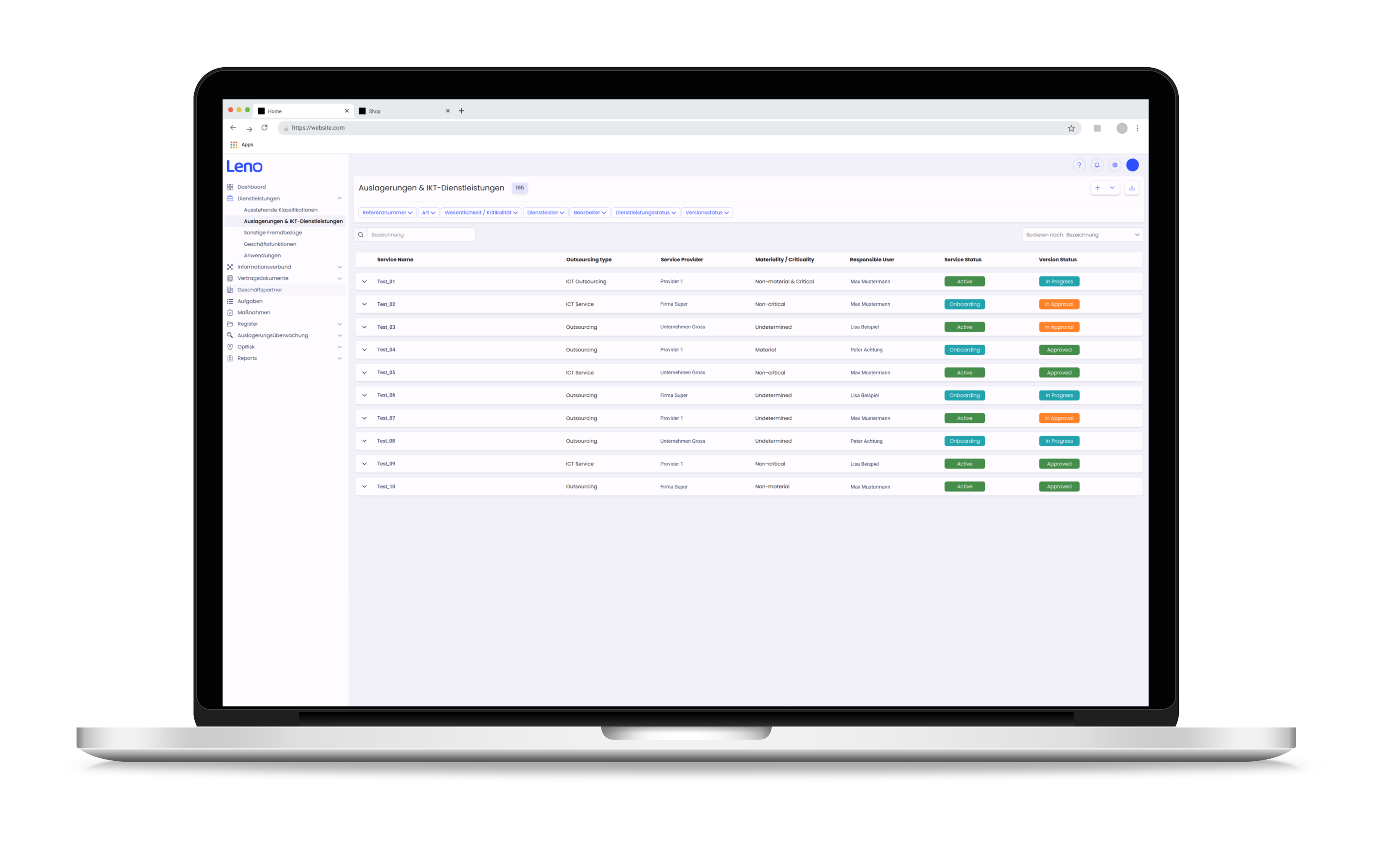
Why conducting a BIA is a challenge
- Critical and non-critical processes are not clearly distinguished
- The impact of outages is assessed inconsistently
- Priorities for recovery are not clearly defined
- BIAs are conducted using spreadsheets or individual queries
- Process owners must provide many unclear inputs
- Calculations are performed manually and are prone to errors
- Changes to processes are not systematically considered
- Key figures must be maintained multiple times
- Versioning is difficult to trace during audits
%20%202.png)
How Leno supports the Business Impact Analysis
- Uniform recording of business processes and their assets
- Standardized assessment logic across all organizational units
- Clear assignment of responsibilities
- Derivation of time criticality based on defined criteria
- Automated calculation of recovery objectives
- Reduction of manual sources of error
- Inheritance of time criticality to applications, systems, and outsourcing
- Use of BIA results in BCM and ICT risk management
- Unified data basis for other modules in Leno
%20%202%20(1).png)
Why the BIA can be implemented more efficiently with Leno
Many organizations conduct BIAs manually or with isolated tools. These approaches are time-consuming, error-prone, and hardly scalable.
Other Tools



.png)
.png)
.png)
Key questions about the Business Impact Analysis
1. Was ist die Leno?
Leno ist eine modulare Plattform für Governance, Risk & Compliance (GRC), die Unternehmen bei der Automatisierung und Digitalisierung von Compliance- und Risikomanagement-Prozessen unterstützt. Mit Leno etablieren Sie Auslagerungsmanagement, Vertragsmanagement, Informationssicherheit und BCM etablieren.
2. Welche Module bietet Leno?
Leno ist modular, integriert und automatisiert.
Aktuell stehen folgende Module zur Verfügung:
- Leno TPRM – für Third Party Risk Management und Auslagerungsmanagement
- Information Security & Resilience (ISR) – für Informationssicherheitsmanagement und Business Continuity Management (BCM)
- Leno CLM – für Vertragsmanagement
Alle Module greifen nahtlos ineinander und bilden gemeinsam ein ganzheitliches Governance-, Risk- und Compliance-Management (GRC) ab.
3. Wie ist die Leno Plattform technisch aufgebaut?
Leno ist eine webbasierte Cloud-Plattform, entwickelt nach modernen Sicherheits- und Architekturstandards. Die Lösung ist skalierbar, mandantenfähig und kann flexibel an Ihre internen Strukturen, Prozesse und Berechtigungen angepasst werden.
4. Ist Leno sicher?
Ja. Sicherheit steht bei Leno an oberster Stelle. Die Plattform erfüllt höchste Anforderungen an Datenschutz, Informationssicherheit und Compliance. Alle Daten werden verschlüsselt gespeichert und übertragen, und das Hosting erfolgt in zertifizierten Rechenzentren innerhalb der EU.
5. Kann Leno in bestehende Systeme integriert werden?
Ja. Über standardisierte Schnittstellen (APIs) kann Leno problemlos in bestehende Systeme wie ERP-, GRC- oder CMS-Lösungen integriert werden. Damit lassen sich Daten für Dienstleister, Verträge und Risiken effizient synchronisieren.
6. Ist Leno mehrsprachig verfügbar?
Ja. Die Plattform unterstützt standardgemäß Deutsch und Englisch. Weitere Sprachen können auf Anfrage ergänzt werden.
7. Wie erfolgt die Benutzerverwaltung?
Kunden authentifizieren sich über Single Sign-On (SSO).Leno bietet eine rollenbasierte Benutzer- und Rechteverwaltung, mit der sichergestellt wird, dass Ihr Berechtigungskonzept automatisch abgebildet wird.
8. Welche Unterstützung bietet Leno beim Onboarding und Support?
Unsere Experten begleiten Sie von der Einführung bis zum produktiven Betrieb. Wir bieten Schulungen, technische Unterstützung und laufenden Support, um eine reibungslose Nutzung der Plattform sicherzustellen. Auf Wunsch übernehmen wir auch die initiale Datenmigration und Konfigurationen, sofern notwendig.
9. Wird Leno regelmäßig aktualisiert?
Ja. Leno wird kontinuierlich weiterentwickelt. Regulatorische Änderungen, Optimierungen und neue Funktionen werden regelmäßig bereitgestellt, sodass Sie immer auf dem neuesten Stand bleiben.
10. Welche Vorteile bietet Leno gegenüber anderen GRC-Plattformen?
- Hoher Automatisierungsgrad durch KI- Modularer Aufbau
und flexible Erweiterbarkeit
- Schnelle Implementierung und intuitive Benutzeroberfläche
- Regulatorische Expertise direkt in der Software abgebildet
- Hosting & Support aus Deutschland
Die BIA bewertet die Auswirkungen eines Ausfalls von Geschäftsprozessen in Abhängigkeit mit der Ausfalldauer und legt fest, wie schnell diese wiederhergestellt werden müssen.
The BIA assesses the impact of a business process failure in relation to its downtime and determines how quickly the process must be restored.
Die Maximal Tolerierbare Ausfallszeit bestimmt die Zeitkritikalität eines Prozesses und beschreibt, ab welchem Zeitpunkt ein Ausfall eines Prozesses zu nicht tolerierbaren Schäden führt.
The Maximum Tolerable Downtime (MTA) determines the time criticality of a process and describes the point at which a process failure would cause unacceptable damage.
RTO (Recovery Time Objective) definiert die maximal tolerierbare Ausfallzeit eines Prozesses. RPO (Recovery Point Objective) beschreibt den maximal tolerierbaren Datenverlust, ab welchem Zeitpunkt ein Ausfall eines Prozesses zu nicht tolerierbaren Schäden führt.
RTO (Recovery Time Objective) defines the maximum tolerable downtime of a process.
RPO (Recovery Point Objective) describes the maximum tolerable data loss, indicating the point in time from which a process failure would cause unacceptable damage.
Eine Business Impact Analyse sollte regelmäßig – mindestens einmal jährlich - überprüft und bei Bedarf aktualisiert werden. Darüber hinaus ist eine anlassbezogene Aktualisierung erforderlich, etwa bei Prozessanpassungen, neuen Abhängigkeiten oder organisatorischen Veränderungen.
A Business Impact Analysis should be reviewed regularly—at least once a year—and updated as necessary. In addition, event-driven updates are required, for example in the case of process changes, new dependencies, or organizational changes. Leno supports the ongoing maintenance of the BIA and ensures that changes are handled consistently and transparently.
Die BIA-Ergebnisse bilden eine zentrale Grundlage für das Business Continuity Management, die IT-Sicherheit und das Auslagerungsmanagement. In Leno können die ermittelten Zeitkritikalitäten und Wiederanlaufziele direkt weiterverwendet und miteinander verknüpft werden.
The BIA results form a central foundation for business continuity management, IT security, and outsourcing management. In Leno, the identified time criticalities and recovery objectives can be directly reused and linked with each other.
