
Transparent sub-outsourcings
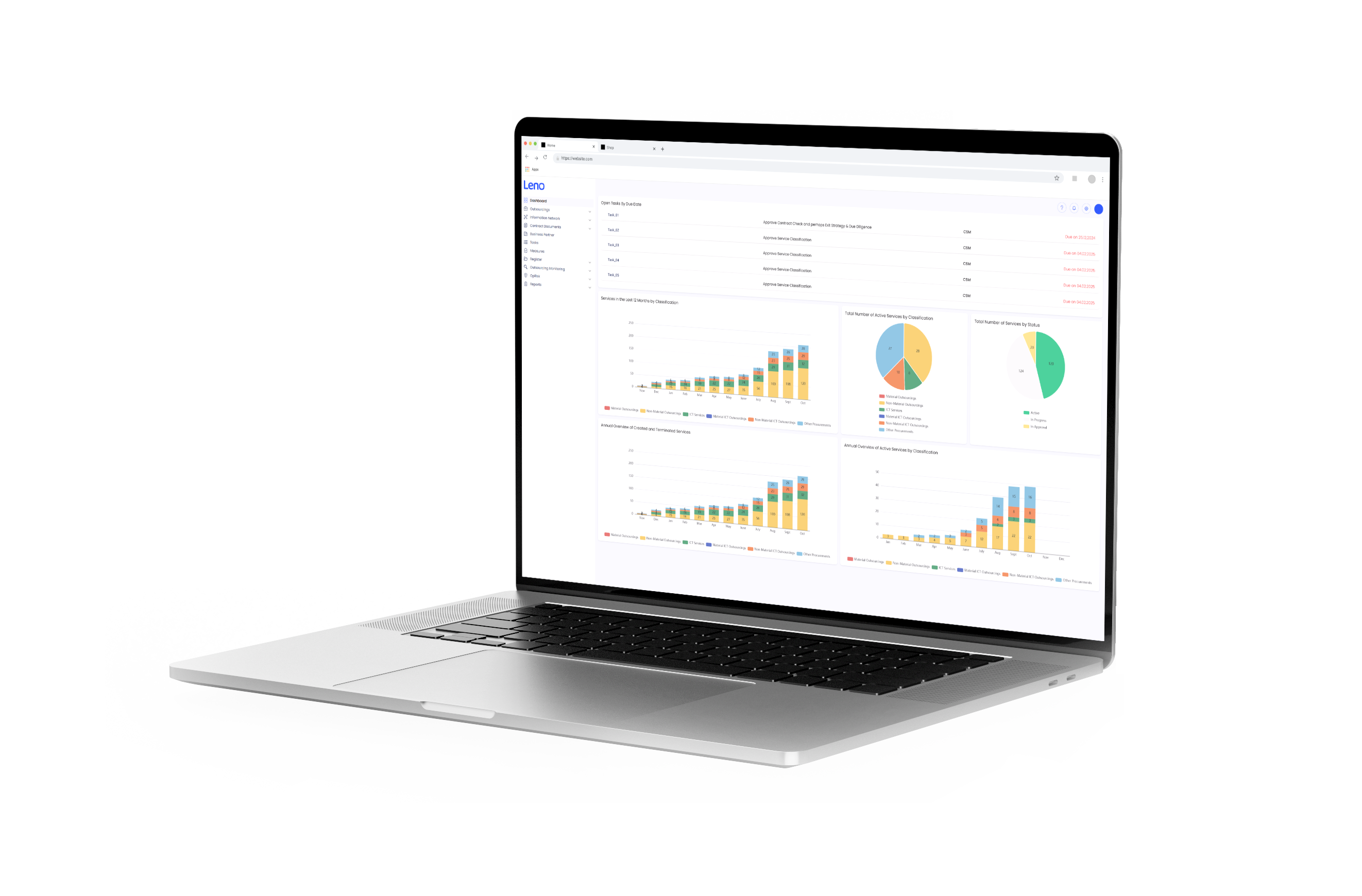
Leno enables efficient and compliant documentation and monitoring of entire outsourcing chains and ICT subcontracting arrangements
Why subcontracting is a challenge
- Missing complete mapping of primary service providers and subcontractors in line with DORA, EBA Guidelines and MaRisk
- Unclear allocation to critical or important functions
- Changes within the supply chain are not systematically captured
- Dependencies between primary service providers and subcontractors are not clearly identifiable
- Concentration and operational resilience risks remain undetected
- Responsibilities along the supply chain are unclear
- Insufficient traceability of risk assessments and approval decisions
- Documentation is not audit-ready or not up to date
- Increased risk of findings by supervisory authorities and internal audit
%201.png)
How Leno manages subcontracting and ICT sub-outsourcing
- Mapping of Primary Service Providers → Subcontractor → Additional Outsourcing Layers
- Allocation to critical and important functions
- Complete change history for all subcontracting arrangements
- Assessment of:
- Criticality
- Concentration risks
- Information security risks
- Data Protection
- Operational Outage and Dependency Scenarios
- Linked with existing ICT risk assessments.
- Regular, audit-proof updates of risk assessments
- Automated Transfer to the Outsourcing Register and the Information Register
- Tracking of changes across the ICT supply chain
%20%202%20(1).png)
Further relocations are documented with basic functions, static workflows or individual solutions — without complete transparency across multi-stage supply chains.
Why Leno manages relocations and ICT services more effectively
Other Tools



.png)
.png)
.png)
Key Questions on Sub-Outsourcings and ICT Subcontracting
1. Was ist die Leno?
Leno ist eine modulare Plattform für Governance, Risk & Compliance (GRC), die Unternehmen bei der Automatisierung und Digitalisierung von Compliance- und Risikomanagement-Prozessen unterstützt. Mit Leno etablieren Sie Auslagerungsmanagement, Vertragsmanagement, Informationssicherheit und BCM etablieren.
2. Welche Module bietet Leno?
Leno ist modular, integriert und automatisiert.
Aktuell stehen folgende Module zur Verfügung:
- Leno TPRM – für Third Party Risk Management und Auslagerungsmanagement
- Information Security & Resilience (ISR) – für Informationssicherheitsmanagement und Business Continuity Management (BCM)
- Leno CLM – für Vertragsmanagement
Alle Module greifen nahtlos ineinander und bilden gemeinsam ein ganzheitliches Governance-, Risk- und Compliance-Management (GRC) ab.
3. Wie ist die Leno Plattform technisch aufgebaut?
Leno ist eine webbasierte Cloud-Plattform, entwickelt nach modernen Sicherheits- und Architekturstandards. Die Lösung ist skalierbar, mandantenfähig und kann flexibel an Ihre internen Strukturen, Prozesse und Berechtigungen angepasst werden.
4. Ist Leno sicher?
Ja. Sicherheit steht bei Leno an oberster Stelle. Die Plattform erfüllt höchste Anforderungen an Datenschutz, Informationssicherheit und Compliance. Alle Daten werden verschlüsselt gespeichert und übertragen, und das Hosting erfolgt in zertifizierten Rechenzentren innerhalb der EU.
5. Kann Leno in bestehende Systeme integriert werden?
Ja. Über standardisierte Schnittstellen (APIs) kann Leno problemlos in bestehende Systeme wie ERP-, GRC- oder CMS-Lösungen integriert werden. Damit lassen sich Daten für Dienstleister, Verträge und Risiken effizient synchronisieren.
6. Ist Leno mehrsprachig verfügbar?
Ja. Die Plattform unterstützt standardgemäß Deutsch und Englisch. Weitere Sprachen können auf Anfrage ergänzt werden.
7. Wie erfolgt die Benutzerverwaltung?
Kunden authentifizieren sich über Single Sign-On (SSO).Leno bietet eine rollenbasierte Benutzer- und Rechteverwaltung, mit der sichergestellt wird, dass Ihr Berechtigungskonzept automatisch abgebildet wird.
8. Welche Unterstützung bietet Leno beim Onboarding und Support?
Unsere Experten begleiten Sie von der Einführung bis zum produktiven Betrieb. Wir bieten Schulungen, technische Unterstützung und laufenden Support, um eine reibungslose Nutzung der Plattform sicherzustellen. Auf Wunsch übernehmen wir auch die initiale Datenmigration und Konfigurationen, sofern notwendig.
9. Wird Leno regelmäßig aktualisiert?
Ja. Leno wird kontinuierlich weiterentwickelt. Regulatorische Änderungen, Optimierungen und neue Funktionen werden regelmäßig bereitgestellt, sodass Sie immer auf dem neuesten Stand bleiben.
10. Welche Vorteile bietet Leno gegenüber anderen GRC-Plattformen?
- Hoher Automatisierungsgrad durch KI- Modularer Aufbau
und flexible Erweiterbarkeit
- Schnelle Implementierung und intuitive Benutzeroberfläche
- Regulatorische Expertise direkt in der Software abgebildet
- Hosting & Support aus Deutschland
Eine Weiterverlagerung liegt vor, wenn ein Dienstleister Leistungen, die er für ein Finanzinstitut erbringt, ganz oder teilweise an einen Dritten auslagert. Dies gilt unabhängig davon, ob die Auslagerung dauerhaft oder temporär erfolgt. Sind von dieser Weiterverlagerung Leistungen der Informations- und Kommunikationstechnologie (IKT) betroffen, spricht man von einer IKT-Unterauftragsvergabe.
A further outsourcing occurs when a service provider outsources all or part of the services it provides to a financial institution to a third party. This applies regardless of whether the outsourcing is permanent or temporary. If the outsourced services involve information and communication technology (ICT), this is referred to as an ICT subcontracting arrangement.
Nicht jeder Unterauftragnehmer muss formal genehmigt werden – entscheidend ist die Risikorelevanz. Unterauftragnehmer, die Leistungen im Zusammenhang mit kritischen oder wichtigen Funktionen erbringen oder wesentliche IKT-Risiken beeinflussen, müssen vorab bewertet und genehmigt werden. Bei nicht-kritischen Leistungen kann eine vereinfachte Dokumentation ausreichen.
Not every subcontractor needs formal approval - the key factor is risk relevance. Subcontractors providing services related to critical or important functions or significantly affecting ICT risks must be assessed and approved in advance. For non-critical services, simplified documentation may be sufficient.
Die Dokumentation muss so tief gehen, dass Risiken aus Weiterverlagerungen vollständig nachvollziehbar und steuerbar sind. Solange aus einer Weiterverlagerung ein Risiko entstehen kann, das für das Institut relevant ist, müssen Bewertung, Entscheidungsgrundlage, Genehmigung und Überwachung dokumentiert sein.
The documentation must be detailed enough to ensure that risks from further outsourcing are fully traceable and manageable. As long as a further outsourcing arrangement can generate a risk relevant to the institution, the assessment, decision basis, approval, and monitoring must be documented. Supervisors and auditors must be able to see at any time which further outsourcing arrangements exist, which risks have been assessed, and how they are being managed.
Leno stellt alle prüfungsrelevanten Informationen zu Weiterverlagerungen zentral, aktuell und nachvollziehbar bereit. Risikoanalysen, Genehmigungen, Entscheidungen und Änderungen in der IKT-Lieferkette sind strukturiert dokumentiert und jederzeit revisionssicher abrufbar.
Leno provides all audit-relevant information on further outsourcing centrally, up-to-date, and in a traceable manner. Risk analyses, approvals, decisions, and changes in the ICT supply chain are documented in a structured way and can be accessed at any time in an audit-proof manner. This allows institutions to respond quickly and consistently to internal audits, external auditors, and supervisory authorities without manually compiling information.
Aufsichtsrechtlich wird erwartet, dass Finanzinstitute auch Transparenz und Kontrollmöglichkeiten über Unterauftragnehmer haben, die im Rahmen von Weiterverlagerungen eingesetzt werden. Entscheidend ist nicht nur der Vertrag, sondern die tatsächliche Überwachung der gesamten IKT-Lieferkette.
Regulatory expectations require that financial institutions also maintain transparency and control over subcontractors used in further outsourcing. It is not sufficient to have a contract alone; the entire ICT supply chain must be actively monitored. The institution remains fully responsible even for subcontractors and must be able to assess risks, document approvals, and track changes.
